
Self-Serve AI vs Done-for-You Property Media — Which Path Fits?
Some teams want software and speed. Others want to upload and walk away. Compare self-serve AI in ReHub Studio with done-for-you media paths so you choose the right operating model.
Key Takeaways
- The right path depends on capacity and control — not which option sounds more modern.
- Self-serve wins on speed of iteration once the team is trained.
- Done-for-you wins when you need craft, overflow capacity or specialist shoots.
- Hybrid models are normal and often optimal.
- ReHub Studio supports self-serve tools; Studio / partners can cover DFY needs.
Property marketing has split into two honest offers. One says: here are the tools — produce at the speed of your diary. The other says: send us the brief — we will return the package. Both can be excellent. Both can fail if you pick them for the wrong reasons.
This guide helps you choose a primary path — and a hybrid if that is wiser — across the ReHub Studio world and traditional media production.
Self-serve AI: what it really demands
Self-serve with apps like PhotoClear, PhotoEdit, Staging, HyperDusk and ImageMotion inside ReHub Studio gives you:
- Same-day changes without supplier lag
- Direct control over style
- Shared credit flexibility
- Tight loops with negotiators
It also demands:
- Someone accountable for quality
- Basic training and standards
- Willingness to own disclosure and QA
If nobody “owns media” in the branch, self-serve becomes inconsistent quickly. Fix ownership first — see multi-branch standards.
Done-for-you: what it really buys
DFY (whether through Studio, a photographer network, or a full-service agency like Photoplan) buys:
- Specialist capture craft
- Overflow capacity
- Predictable SLAs when your team is maxed out
- Prestige execution for flagship homes
Trade-offs:
- Less instant iteration
- Briefing quality becomes critical
- Per-job cost structures differ from credit packs
- You must still manage brand standards upstream
DFY is not “set and forget” if your brief is vague.
Side-by-side comparison
| Factor | Self-serve AI | Done-for-you |
|---|---|---|
| Speed of small tweaks | Excellent | Slower |
| Peak-week scalability | Depends on staff | Often stronger |
| Craft on complex shoots | Variable | Usually stronger |
| Cost predictability | Credits / seats | Job or retainer pricing |
| Brand control | High if skilled | High if briefed |
| Appraisal storytelling | Show your process live | Show supplier portfolio |
| Best for | Everyday volume | Prestige + overflow |
Hybrid: the model most teams should consider
A practical split:
- Self-serve: declutter, exposure fixes, social video from stills, selective staging, dusk refreshes
- DFY: photography attendance, measured plans, full tours, cinema films, development CGI
This mirrors the day-in-the-life workflow: in-house enhancements on top of solid capture — whoever captured it.
Decision checklist
Choose self-serve-heavy if:
- You already have a media-minded staffer
- Volume is steady and similar each week
- Appraisals sell your in-house marketing machine
- You need evening turnarounds before portal peaks
Choose DFY-heavy if:
- Nobody has time to learn tools properly
- Quality variance across branches is already a problem you cannot staff
- Your differentiator is white-glove service
- Capture complexity is high (prestige, drone, multi-unit)
Choose hybrid if both lists feel half-true — they usually do.
Cost is not only the invoice
Include:
- Staff minutes (self-serve is not free)
- Rework from unclear DFY briefs
- Missed weekend traffic when either path delays
- Training and credit waste
- Opportunity cost of weak appraisal proof
The cheapest line item can be the most expensive operating model.
How to pilot without drama
- Pick one branch
- Run 20 listings self-serve for enhancements
- Keep DFY capture if needed
- Measure turnaround, vendor feedback and thumbnail quality
- Only then rewrite packages and pricing
Avoid announcing a network-wide revolution on day one.
Talking to vendors about your model
Vendors care about outcomes, not your org chart.
Self-serve story: “We control the marketing package in-house so we can react the same day.”
DFY story: “Specialist media partners deliver a premium package to a fixed standard.”
Hybrid story: “Experts capture; our team enhances and publishes at speed.”
Pick one primary sentence and stick to it in appraisals — consistency builds trust.
Where ReHub fits
ReHub Studio is the self-serve spine: one login, shared credits, connected apps for the enhancement and presentation layer. Studio and specialist partners cover teams that want more hands-off delivery. You are not forced into a false binary — you are choosing an operating mix.
Onboarding a self-serve team without quality collapse
Self-serve fails in the first 90 days when training is “here is a login” and nothing else. Treat onboarding like a new hire, not a software trial.
Week-by-week rollout:
| Week | Focus |
|---|---|
| 1 | One-page standards + three worked examples |
| 2 | PhotoEdit and PhotoClear on live files — supervised |
| 3 | Staging and disclosure rules — supervised |
| 4 | ImageMotion social cuts + publish QA |
| 5+ | Solo with random audit of 1 in 5 listings |
Nominate one quality owner who sees thumbnails before portal upload on every instruction until the team proves consistency. That person does not need to be a designer — they need permission to say no to a dark hero.
Build a shared folder of “approved” and “rejected” examples from your own stock. Generic stock training slides do not land like your branch’s actual crooked exterior from last Tuesday.
Credit discipline matters from day one. Teams that treat shared credits as unlimited often burn budget on experimental staging every room — then wonder why finance pushes them back to DFY.
When to escalate from self-serve to done-for-you
Hybrid models need clear escalation rules or everything drifts to the easiest path.
Escalate to DFY when:
- Drone, twilight attendance or complex multi-building capture is required
- The property is flagship (£ top decile for your patch) and brand risk is high
- Self-serve queue would miss a bank holiday launch window
- Measured survey or legal plan accuracy is non-negotiable
- Staff illness leaves no quality owner for a fortnight
Stay self-serve when:
- Changes are incremental (declutter, exposure, one staged room)
- Social video can be cut from existing stills
- Volume is high but homogenous (lettings blocks, similar semis)
- The negotiator needs same-day turnaround for a price change
Write escalation triggers in the package matrix so negotiators know Premium DFY capture is not snobbery — it is capacity and craft allocation.
Contracts, SLAs and hybrid handoffs
Hybrid only works when handoffs are boringly explicit.
DFY supplier brief should include:
- Gallery order and hero preference
- Rooms approved for staging
- Plan format and portal placement
- Video length and branding
- Turnaround clock start (usually on receipt of select, not raw dump)
Self-serve enhancement brief (internal) should include:
- Which frames get declutter vs leave honest
- Disclosure list for portal upload
- Who publishes and who checks live thumbnail
When DFY delivers capture and in-house adds AI enhancements, agree file delivery format once — inconsistent RAW/JPEG handoffs cause rework and colour drift.
Review hybrid SLAs quarterly: if DFY always waits on your team for selects, the bottleneck is internal; if self-serve always slips on staging, you may need more DFY overflow hours in peak season.
Bottom line
Self-serve AI vs done-for-you is not a morality play about modern versus traditional. It is an operations choice about control, capacity and brand promise. Be honest about your team’s skills, pick a primary path, allow a hybrid for reality, and measure whether listings go live looking like the agency you describe in the appraisal — every time.
Frequently Asked Questions

The ReHub Studio Team
Property Marketing Experts
The ReHub Studio team builds AI-powered tools that help estate agents, photographers and developers create better property marketing, faster.
Ready to improve your property marketing?
Enhance photos, remove clutter, stage rooms, produce floor plans, create video and publish listings from one ReHub account.
Related Articles

Introducing HIOZ: The Video-First AI Guest Guide for Short-Term Rentals
Meet HIOZ, the new video-first AI guest guide from ReHub Studio. Turn one property walkthrough into secure, multilingual answers for every guest.
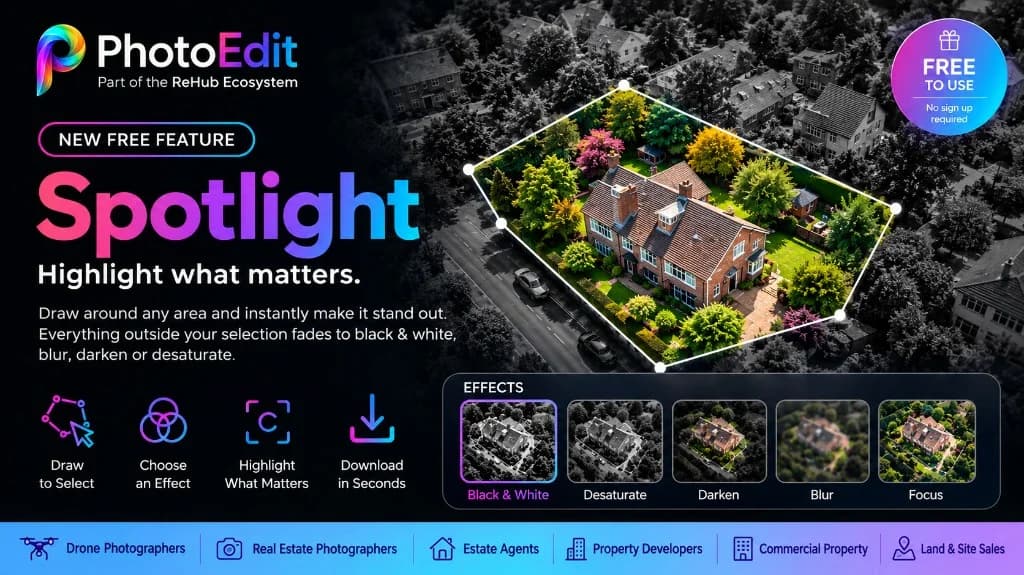
Introducing Spotlight: The Free Property Highlight Tool for Aerial Photos
Spotlight is a free PhotoEdit feature that lets you draw around any property or area in an aerial photo and fade everything else — no Photoshop required.

Introducing 360Worlds: A New Immersive Platform Built on ReHub Studio's 360° Tour Technology
From property marketing to immersive education and entertainment, discover how the technology behind ReHub Studio is powering an entirely new platform: 360Worlds.